
Defense is introduced after the basic attacking techniques have been learned and then develops alongside them through partner work. Only with a partner can distance, timing, and the direction of an attack be practiced fully.
Pair exercises are performed with serviceable training weapons, the required protective equipment, and tasks, speed, and contact force agreed in advance.
NMA defensive actions fall into four broad groups:
The weapon intercepts or changes the trajectory of an attack. Depending on the type of interaction, weapon defenses include:
- block — a firm stop of the attack with the defending weapon;
- gliding deflection — tangential blade contact that allows the opponent’s strike to pass along a safe trajectory;
- beat — a short, active impact that changes the attack’s trajectory;
- bind — maintained contact and pressure used to control the partner’s weapon or the central line.
Whenever possible, contact is received on the strong or middle part of one’s own blade against the middle or weak part of the opponent’s blade, while maintaining body structure and keeping the hands and elbows off the line of attack.
An attack may fail to reach its target through:
- breaking distance;
- moving sideways relative to the line of attack;
- closing distance while simultaneously entering inside the effective arc of the attack, closing the threatened line, or binding the weapon.
Defense through movement requires a good sense of distance and command of the necessary footwork. An evasion should not become an uncontrolled, heavy movement that the opponent can exploit.
Defense through body positioning removes the torso or another body part from the line of attack without substantially changing distance, while preserving balance and readiness to continue. Options include:
- changing the position of one or both arms;
- evading with the head;
- evading with the torso;
- ducking;
- withdrawing a leg.
A defense can create a threat at the same time: the weapon closes the threatened line while keeping the point or striking part directed at the opponent.
In some cases, the weapons do not make direct contact. Controlling space with the blade or by closing distance can limit the opponent’s options, disrupt the preparation of an attack, or force them to change their action.
An attack can also be performed while simultaneously binding the opponent’s weapon. However, a counterattack alone is not a defense. If the line remains open and both participants are hit, the defensive task has not been completed.
a good defense does five things
- begins at the right time;
- reliably closes the threatened line;
- uses the minimum necessary movement while preserving balance and body structure;
- protects the hands and forearms;
- ends in a position that allows a response, continued control, or a safe exit from contact.
Basic NMA blocks
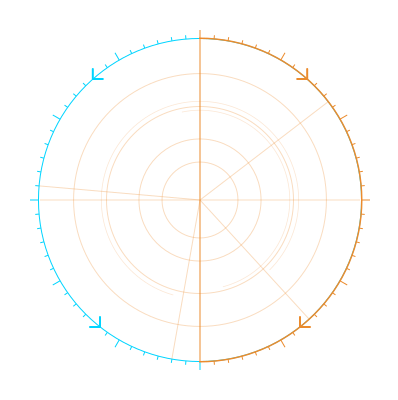
The system is based on two mirrored downward semicircles and two upward semicircles. Points on them define characteristic blade positions, while vectors extending from those points show the blade’s direction of movement at that moment. Empty-hand blocks are classified according to the same principle.
Basic blocks follow a broad trajectory. They provide a clear starting form from which defense gradually becomes softer, more compact, and more economical.
Downward Semicircle
As the blade travels along the semicircle, it passes through three main positions:
Upward Semicircle
The upward trajectory creates three further reference positions:
Classical fencing parries cover four main sectors. In NMA, however, the upper and lower sectors overlap around the torso, so this area can be protected with blocks characteristic of either group.
The similarity to classical parries concerns primarily the weapon position and the line being closed. NMA combines Western and Eastern techniques, while its classification system is based primarily on biomechanics and therefore does not depend on the type of weapon—or on whether a weapon is used at all.
Extended information is available to registered club members.