
Basic NMA striking technique is built around two directional patterns—the straight and diagonal crosses—and a forward thrust.
The crosses provide a clear coordinate framework for studying trajectory, body mechanics, and weapon control. However, they do not encompass the whole concept of an attack. A complete attack also includes preparation, control of distance and timing, interaction with the opponent’s weapon, and a safe conclusion to the action.
Coordinate system
Straight Cross
It contains four directions:
- vertical from above;
- horizontal from left to right;
- horizontal from right to left;
- vertical from below.
A technically sound attack preserves balance, visual control, and hand protection; reaches the target along an economical trajectory; does not overload the joints; and ends in a position that allows the practitioner to continue the action or safely leave the distance.
Diagonal Cross
It contains four diagonal directions:
- descending from the left;
- descending from the right;
- ascending from the left;
- ascending from the right.
The notional intersection of the trajectories lies at the center of the torso and serves as a geometric reference when learning the basic strikes. In practical work, the direction is determined by the chosen target and the opponent’s position.
Thrust
A thrust can be performed from a stationary position or combined with different types of footwork. The weapon, legs, and torso work together, but the exact sequence depends on distance and the tactical task.
In contact practice, thrusting movements require particularly strict limits on speed, target, and force. They are performed only when permitted by the rules of the exercise and the protective equipment in use.
Trajectory is only the visible part of the attack
A complete attack also includes preparation, control of distance and timing, interaction with the opponent’s weapon, and a safe conclusion to the action.
-
01
Preparation
-
02
Distance + timing
-
03
Interaction
-
04
Safe exit
From Basics to Variation
Once the basic trajectory is understood, the practitioner learns to adapt it to the task:
- use a full swing or shorten it to suit the task;
- vary the swing amplitude and striking force;
- choose the level and direction;
- vary the contribution of the wrist, elbow, shoulder girdle, torso, and legs while preserving their coordinated operation as a single kinetic chain.
Choose how much preparation the opponent can see
By the extent of the swing, we conventionally distinguish:
180°Full swing
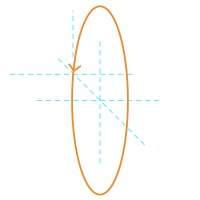
A broad preparatory trajectory.
90°Reduced swing
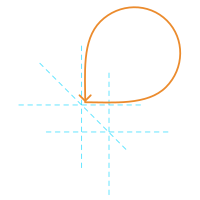
A swing to the side relative to the subsequent line of attack, used for speed and compactness.
0°Attack without visible preparation
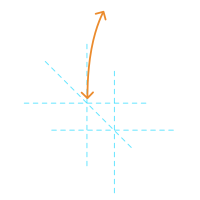
A short backswing along the line of attack in the opposite direction.
Direct the impulse through or along the target
By the way impulse is transferred to the blade:
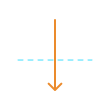
Chop
The primary movement travels across the surface and into the target.
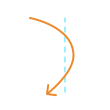
Cut
The blade continues moving along the surface.
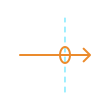
Thrust
The movement travels primarily along the weapon’s longitudinal axis.
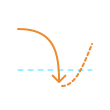
Blow
Similar to chopping attacks but performed with a shorter swing and a whip-like motion; the strike is not intended to penetrate deeply into the target.
The same trajectory can arrive on either edge
By the edge of the sword used to strike:
- true edge — the cutting edge;
- false edge — the back edge.
This classification is not intended to multiply techniques mechanically, but to show which movement parameters can be varied deliberately.
Extended information is available to registered club members.